TEAM
Just me
 HJORTUR FREYR
A daily guessing game built around one idea: a movie poster is still recognisable long after it stops being readable. The whole build is an argument with that idea — how much can you take away before the picture stops being a puzzle and starts being noise?
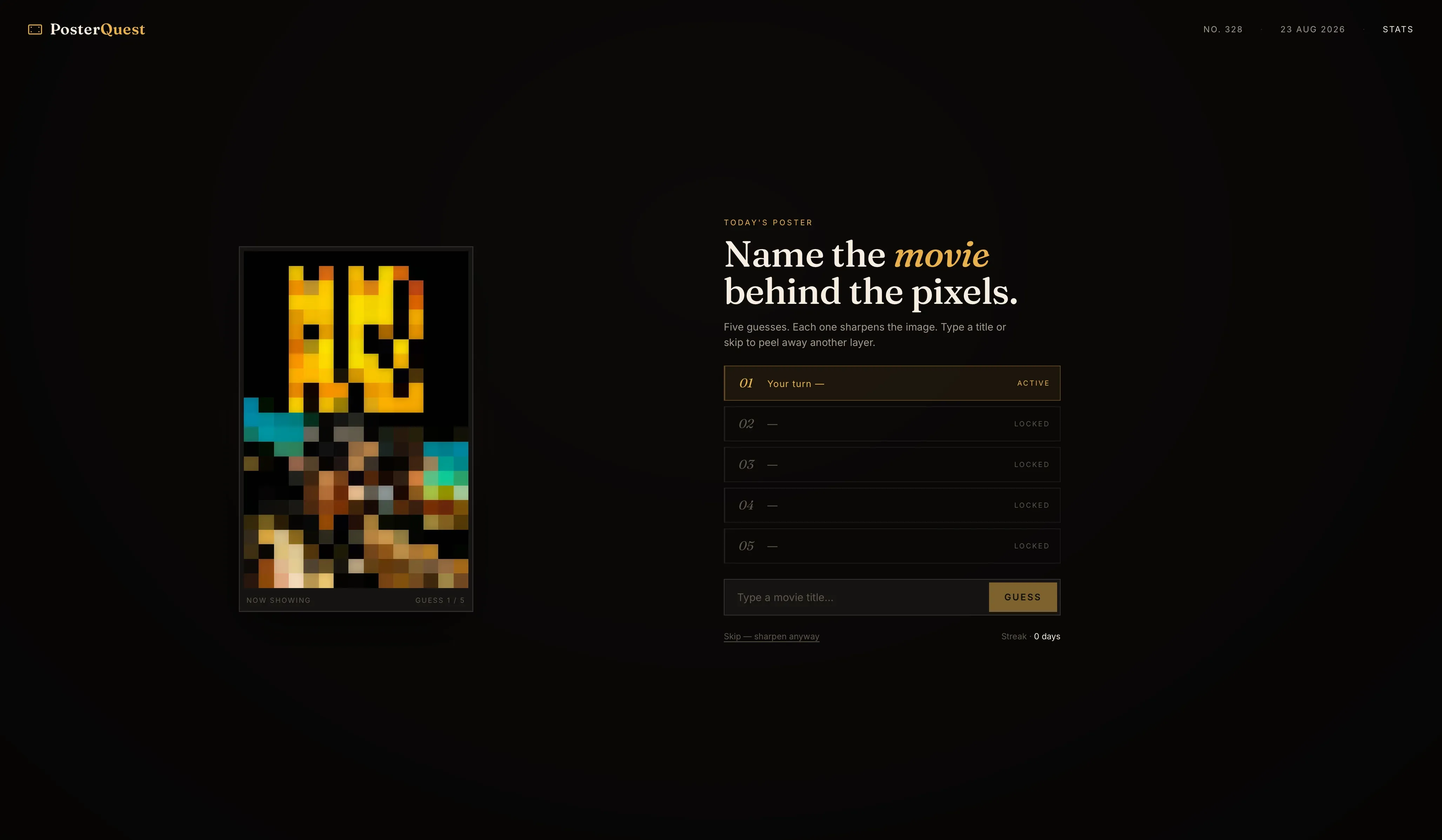
Every daily puzzle game has the same structural weakness: the answer has to reach the browser before the player earns it. Wordle gets away with it because the answer is five letters buried in a word list. Here the answer *is* the artwork — one `<img>` tag pointed at the TMDB CDN and the game is over before the first guess.
The obvious fix is to pixelate on the server and only ever ship the degraded image. I built the route for it and then didn't use it. Server-side pixelation means an image round-trip on every single guess, and the whole feel of the game is that the poster sharpens *instantly* when you're wrong. The latency would have cost more than the leak.
Two of these are about protecting the answer. The third is about making a random daily pick behave like a scheduled one.
The poster is drawn to a canvas, downscaled to 2–32 pixel blocks with smoothing off, upscaled back, and read out as a data URL. The original never renders. If pixelation throws, the code retries at maximum obscurity rather than falling back to the real image — and if the retry also fails, the poster stays in its loading state forever. A visible bug beats a spoiled puzzle.
Six route handlers stand between the browser and TMDB, so the API key never ships to the client. The credits route is the clearest case: the game needs to know a film's director to detect near-miss guesses, so the endpoint returns a single `director_id` and nothing else. The client is told what it needs, not what it asked for.
A Vercel cron runs at 00:00 UTC, picks the next day's film, and upserts it into Postgres keyed by date. The live route reads that cache first and only falls back to picking one itself. The daily movie stops being a computation the first player triggers and becomes a row that already exists.
Pixel block size runs 80 → 60 → 40 → 25 → 15, and the numbers came from playing rather than from theory. The original plan stepped down to a clean zero on the last guess; that turned the fifth guess into a giveaway, so the floor moved up to 15 and full resolution now only arrives when the game is actually over. Two canvases handle it — one to shrink, one to blow it back up with `imageSmoothingEnabled` off, which is what gives the blocks their hard edges instead of a blur.
Guess a film that shares a franchise, a director, or three or more genres with the answer and the row lights amber instead of red. It is the one mechanic that makes wrong answers informative, and it took the most tuning: matching on production company was tried and removed, because major studios connect films that have nothing to do with each other, and the genre threshold climbed to three before it stopped firing on every blockbuster.
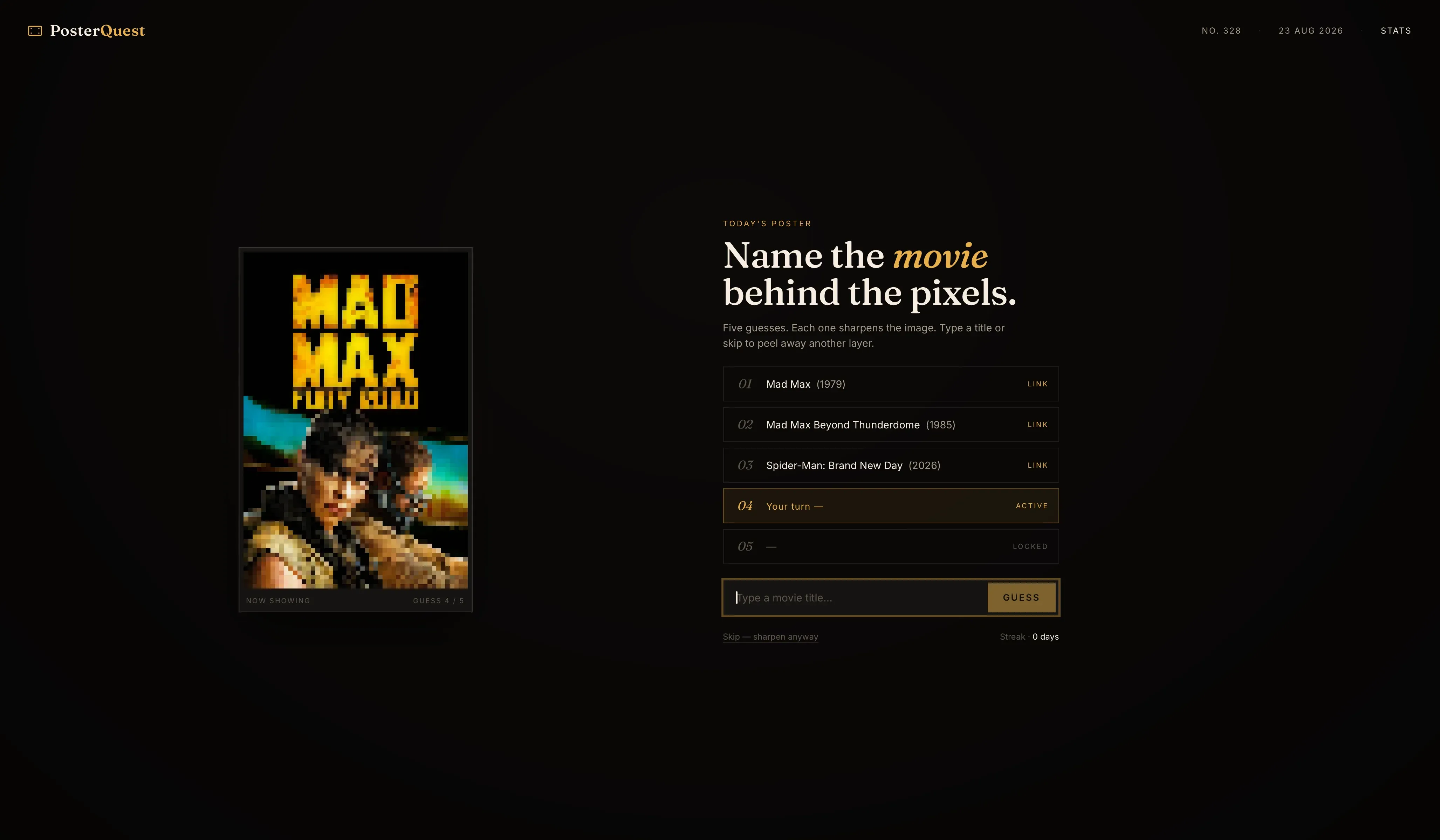
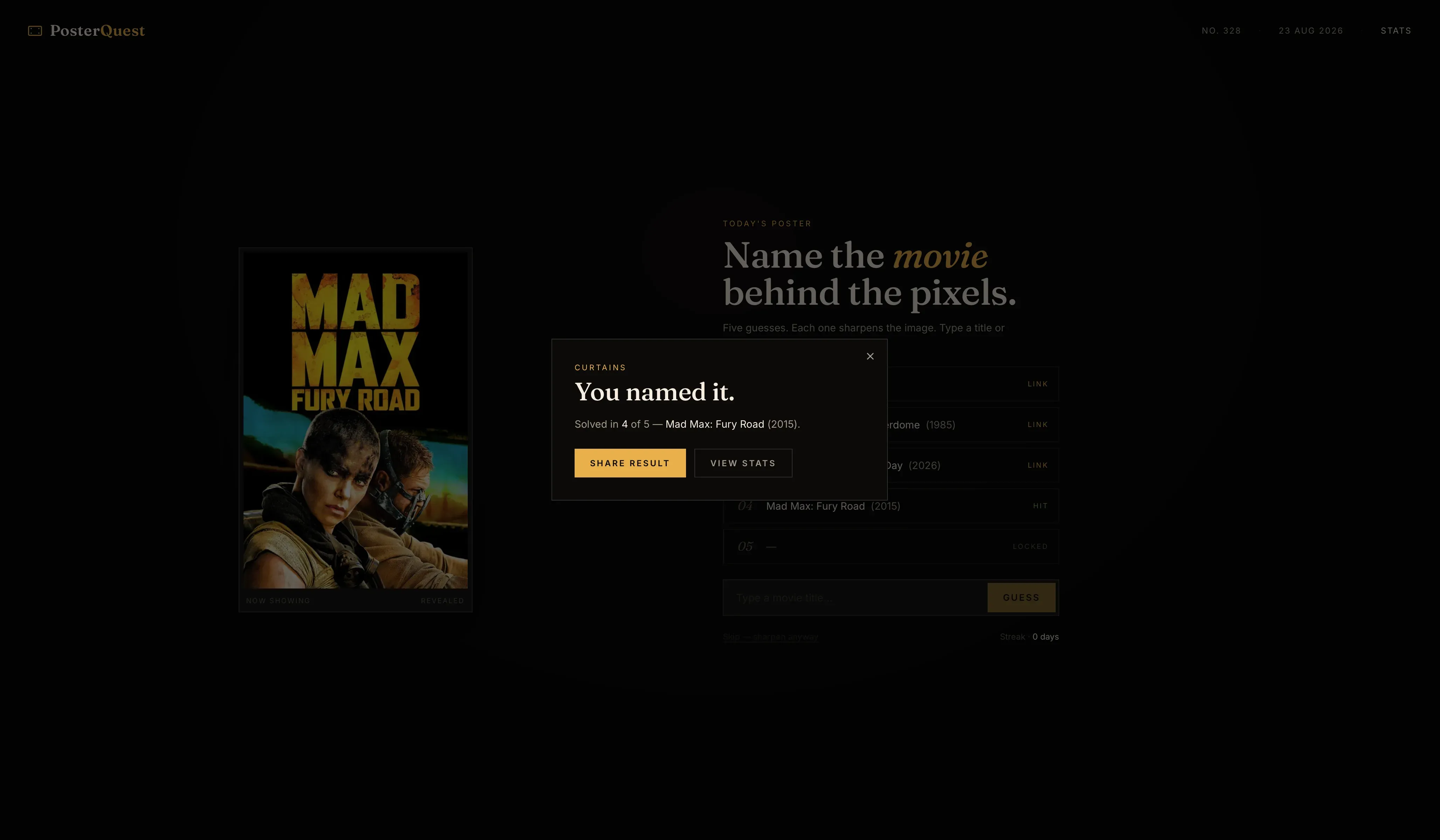
An emoji grid — green hit, amber link, orange skip, red miss — plus a stats panel with win rate, guess histogram, and a streak counter computed over UTC calendar days. The share button falls through three APIs before giving up: the async clipboard, then `execCommand`, then the native share sheet. There is also a skip: burn a guess to sharpen the poster without answering, which reads as an orange square to everyone you send the grid to.
The daily pick has to be identical for every player, and it gets decided in three different places: the cron at midnight, the live API route when the cache is cold, and the client reading it back. There is no shared state between them at the moment of the decision. The pick is a seeded pseudo-random index — `sin(seed) * 10000`, keyed on the UTC date — over a candidate pool pulled from TMDB's discover endpoint.
That works right up until the pool shifts. TMDB sorts by popularity, popularity moves daily, and the same seed against a reordered list returns a different film. So the seed stopped being the source of truth and the database did: the cron writes the chosen movie into a `daily_movies` row keyed by date, and every other path reads that row before it considers picking anything itself. The seeded function survives only as the cold-start fallback.
On top of that sits a 200-day repeat window — the cron reads back recently used movie IDs and re-rolls if it lands on one. Against a pool of roughly sixty candidates that constraint is genuinely tight, so both paths log the squeeze and fall back to the unfiltered list rather than fail. A repeat is a bad day. No movie at all is a broken game.